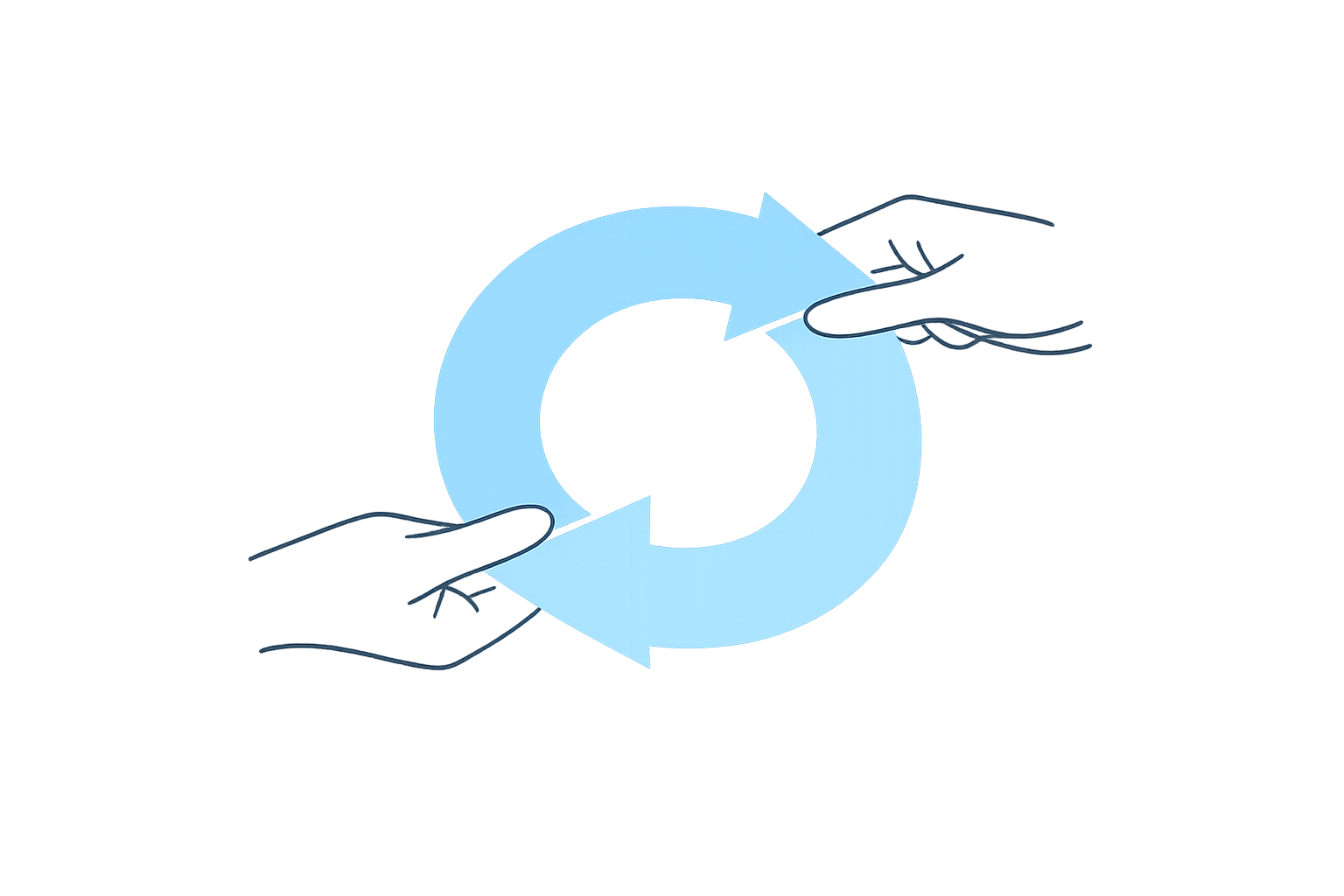
A clinical agent is defined not just by polished answers, but by its ability to recognize uncertainty, step back, retry, or escalate when needed. Recovery and escalation are therefore core behaviors, and should be measured explicitly rather than absorbed into an overall performance score.
A systematic review of human and LLM collaboration in medicine found that gains remain mixed, context dependent, and sometimes offset by persistent factual errors. For clinical agents, these findings mean that evaluation must move beyond polished outputs alone and toward how the system behaves under uncertainty. Benchmarks should include failed retrieval, conflicting evidence, and cases where the safest action is recovery or escalation rather than continuation.
In healthcare AI, restraint is a capability not a weakness.
Capabilities for Stronger Recovery & Escalation
Stronger recovery usually depends on three linked capabilities. The first is failure detection, where the system recognizes that a fact in the chart is missing, a tool result is malformed, or the available evidence doesn't support the current action. The second is bounded repair, where a retry does more than repeat the same weak step and instead narrows the uncertainty or reduces scope. The third is legible state, so that if the system does recover, the trace still shows what went wrong, what changed, and why continuing is now justified.
Strong escalation usually depends on recognizing when the current path isn't reliable, stopping before the failure compounds, and handing off the case in a form a reviewer can use immediately. In practice, that means making the unresolved state clear, preserving enough context for action, and, when the workflow requires it, routing the case to the right human decision maker. Patient portal emergency recognition is a concrete example of this evaluation problem in a high-risk, patient-facing workflow.
Endpoint metrics alone don't tell us enough in these situations. A system can complete the task while still depending on weak repair, delayed escalation, or hidden reviewer effort. Benchmark and rubric triangulation is useful here because it helps distinguish answer quality from process quality and shows whether apparent success came from behavior that would still create review burden in clinical use. Post-deployment monitoring should track overrides, fallback paths, retries, and escalation clusters so those patterns remain visible after deployment.
Recovery & Escalation Assessment for Deployment
Recovery and escalation quality also help define the release scope a system can realistically support and how independently it can operate in practice. Weak recovery may limit deployment to narrow, supervised branches, while strong escalation with less mature repair can still support workflows where fast, well-structured handoff is more important than autonomous completion. As context-switching behavior becomes more consistent across chart variants, sites, and staffing models, the system can support broader autonomy because it holds up under varying scenarios and environments.
Recovery and escalation don't replace broader validation, but they are meaningful dimensions of agent performance. They're especially useful for tool-using systems where the question isn't only whether the agent reaches an answer, but how it behaves when evidence is weak, tools fail, or the current path is unclear.
Reliable healthcare AI systems are defined as much by how they manage failure as by how often they reach the right answer.
What many clinical teams are still missing is a clearer view of how an agent behaves as it moves through a workflow and why it takes the next step it does. Without the right evaluation and system visibility in place early, those decision points can be hard to inspect and even harder to improve. At Quantiles, we're focused on making these behaviors more visible so teams can 857cc87d9ceb33e92f2631328c6fdbdda414763 correct issues earlier, guide system behavior more deliberately and build useful AI systems faster and more efficiently.
FAQs
Common questions this article helps answer